Posts

Exploring the Opportunities and Limitations of Generative Models in Medical Imaging

This blog explores the opportunities and limitations of generative models, including GANs and Diffusion models, in the field of medical imaging. Generative models like ChatGPT have undeniably achieved remarkable success in language modeling and the entertainment industry, where minor errors, omissions, or inaccuracies are less critical and can be easily corrected through human intervention and iterative refinement. The success of these data-driven generative models is anticipated to have a profound impact in the future, as they harness the collective wisdom of large datasets and efficiently tackle time-consuming, routine tasks. However, the requirements in the medical domain are far more stringent, with a heavy emphasis on accuracy and expert interpretation. For example, the expertise of a skilled specialist is far more valuable than the average opinion of a general practitioner, and there are countless patient-specific cases that cannot be adequately captured by collected data through...
Rethinking Innovation in Academia and R&D

Innovation and Academia: Reflections on Progress and Challenges Over four decades in academia, I have often encountered the recurring themes of innovation, reform, and the call for pioneering research and development (R&D). The mantra of "High Risk, High Return" has emphasized long-term vision over short-term gains. Yet, this relentless focus has led to widespread fatigue, as many innovative efforts remain confined to academic circles, rarely transitioning into practical, impactful industrial applications. Academics who achieve breakthroughs often lack the resources or expertise to transform them into successful commercial products. Furthermore, industry-academia collaborations frequently fall short due to subtle yet pervasive challenges, leaving promising innovations as mere line items on résumés rather than societal advancements. Lessons from History: The Role of Constraints in Driving Innovation Developing effective R&D policies that encourage both technological an...

Utilizing Implicit Neural Representations for Solving Ill-posed Inverse Problems

Image
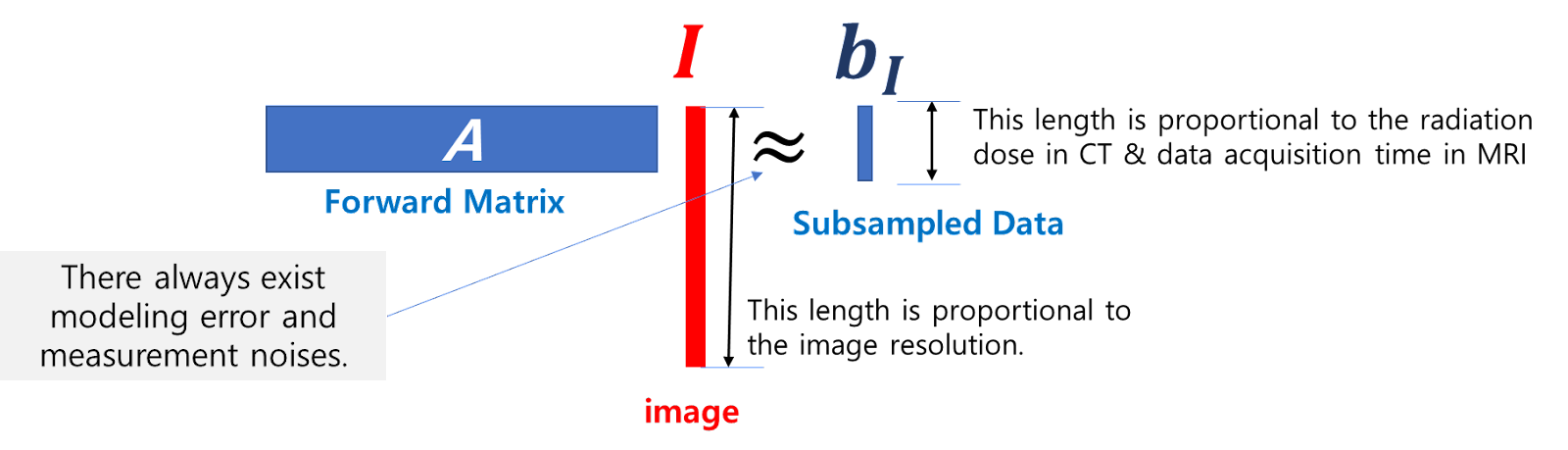
Recently, the field of medical imaging has witnessed numerous attempts aimed at producing high-resolution images with significantly insufficient measured data. These endeavors are motivated by a variety of objectives, such as reducing data acquisition times, enhancing cost efficiency, minimizing invasiveness, and elevating patient comfort, among other factors. Nevertheless, these efforts necessitate tackling severely ill-posed inverse problems, due to the significant imbalance between the number of unknown variables (needed for desired resolution) and the number of available equations (derived from measured data). For a clearer understanding, let's examine a linear system represented by $\mathbf{A}I = \mathbf{b}_{I} + \mathbf{\epsilon}$ , where $\mathbf{A}$ represents an $m \times n$ matrix with a highly underdetermined scenario ( $m \ll n$ ). This matrix $\mathbf{A}$ serves as a linearized forward model. In this formulation, $I$ is an $n$-dimensional vector representing the imag...

Exploring the Fundamentals of Diffusion Models

Image
This blog post explores the recently popular diffusion models. Since there are many excellent explanations available, I don't intend to duplicate their detailed discussions. Rather, I try to offer a succinct summary that highlights the essential principles and foundational concepts behind diffusion models. Diffusion models belong to the family of generative neural network models, alongside Variational Autoencoders (VAEs) and Generative Adversarial Networks (GANs). The term "diffusion" originates from non-equilibrium thermodynamics, wherein particles (images) migrate from high concentration regions (represented by a data manifold filled with structured data) to the low concentration regions (In essence, the vast majority of points within the entire space are overwhelmingly dominated by noisy images). This concept illustrates how diffusion models iteratively refine noise into coherent, structured data by effectively reversing this natural diffusion process. To make the conc...

CT versus MRI: Exploring the Similarities and Distinctions

In this blog post, we take a brief dive into the fundamental principles of Magnetic Resonance Imaging (MRI) and Computerized Tomography (CT), highlighting the inherent differences between the two modalities. While recent strides in AI-driven techniques have enabled simulations of CT from MRI and vice versa, it's essential to recognize the distinct nature of each imaging method. Given their distinct characteristics, one cannot simply replace the other. CT scans offer tomographic (cross-sectional) images based on material linear attenuation coefficients , by directing X-rays through the body from various angles and measuring the decrease in X-ray intensity along linear paths. CT scans outperform MRI in their ability to visualize bone fractures and dense tissues, rendering them indispensable for evaluating traumatic injuries. Despite the ionizing radiation exposure associated with CT scans, they are still utilized for guiding procedures such as biopsies and surgeries, which may not ...

Exploring the Motivations of Compactness in Mathematics through the Riemann-Weierstrass Debate

This blog post delves into the origins of the concept of compactness in mathematics, based on the paper "Compactness and Dirichlet's Principle" by JK Seo and H. Zorgati (J. KSIAM, 2014) .  The concept of compactness was introduced in a pivotal debate between Bernhard Riemann (1826-1866) and Karl Weierstrass (1815-1897), which centered on the convergence issues within Dirichlet's principle concerning the minimization problem. Riemann's approach to Dirichlet's principle posited that for Dirichlet's problem, $\Delta u = 0$ in a  bounded smooth domain $\Omega \subset \mathbb{R}^3$ with boundary data $u|_{\partial\Omega} = \phi \in C(\partial\Omega)$, a solution $u$ could be derived as the limit of a minimizing sequence $\{u_n:n=1,2,\cdots\}$ for the energy functional $f(v) := \int_{\Omega} |\nabla v|^2 dx$, within the admissible set $\mathcal{A} := \{ v \in C^2(\Omega) \cap C(\overline{\Omega}) : v|_{\partial\Omega} = \phi\}$. Riemann essentially claimed  that...

Understanding Noise in Low-Dose CT

Image
 This blog post is about low-dose CT imaging, focusing on how the reduction in radiation dosage can inadvertently introduce increased image noise and artifacts, ultimately impacting the overall image quality. Low-dose CT imaging aims to minimize patient radiation exposure while producing diagnostically valuable images. Reducing radiation exposure for patient safety often leads to a diminished signal-to-noise ratio, as there are fewer photons reaching each detector. Accordingly, reducing radiation exposure often leads to compromised image quality.  The conventional Poisson noise model is inadequate in accurately depicting the complexities of low-dose CT imaging. In reality, the degradation of image quality goes beyond mere heightened image noise. It is also influenced by artifacts arising from sinogram inconsistency, which is caused by subject-dependent beam-hardening associated with the polychromatic X-ray beam.  Moreover, these sources of image degradation interact with ...